
Open Questions and Assumption Registers
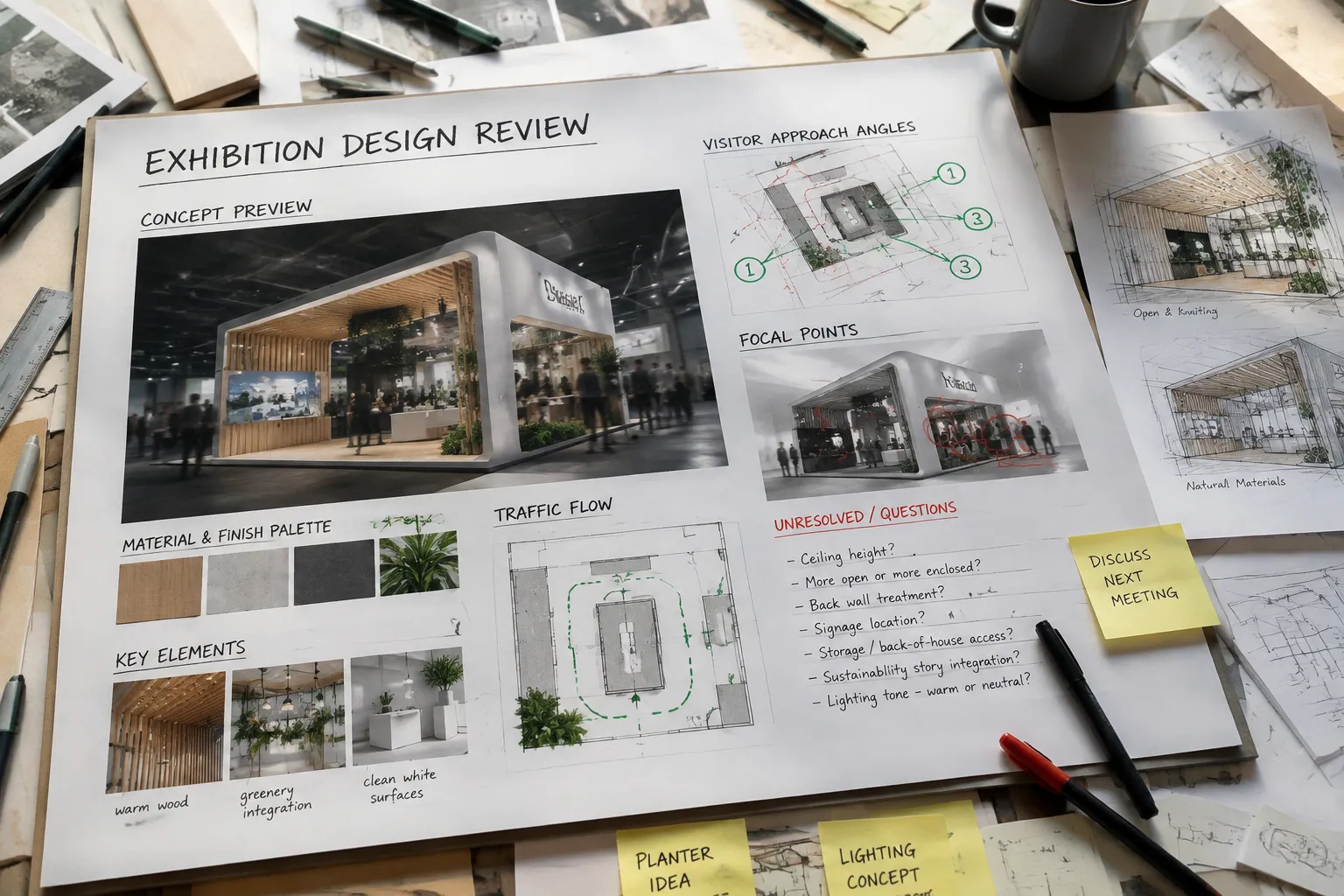
A rendered booth can look resolved while its most consequential decisions remain unstated. From one approach angle, the image may establish a focal point or apparent brand hierarchy. It does not, by itself, confirm dimensions, permissions, venue conditions, accessibility, safety, utilities, buildability, or approval.
A design assumption register keeps that gap visible. It turns a rendered impression into an owned question log: what the team can observe, what the project record confirms, what remains unknown, which review stage applies, and who should provide the next answer.
More specific pages
These pages continue the topic in smaller, more specific directions.
What the Register Holds
Use the register when comparing concept previews, checking a designer's intent, preparing a supplier brief, or moving from campaign imagery toward a more developed handoff. It should not become a transcript of every review comment. Each entry should capture a question that could change a design decision or alter who needs to act next.
A useful entry separates five kinds of information:
- Visible observation: what the concept image shows from a stated approach angle.
- Project evidence: what the brief, drawing, source record, or approved project document confirms.
- Assumption: what a viewer may infer although the available material does not establish it.
- Open question: the specific information still needed.
- Owner and stage: who should provide the next answer and when the question belongs in the review.
This separation matters because a convincing preview can be mistaken for a developed specification. A rendered meeting area may appear private or spacious, yet the image alone does not establish dimensions, acoustic performance, access conditions, or venue suitability.
The register holds that uncertainty without turning it into a premature conclusion.
Begin With the Visitor View
The first field should identify the approach angle or visitor position under review. “The booth looks open” is too broad to route. “From the main aisle, the reception counter and overhead brand mark appear before the demo zone” gives the team something to inspect.
Relevant positions might include:
- the main aisle approach;
- a corner approach between neighboring stands;
- the threshold before a demonstration;
- the edge of a meeting area;
- an expected dwell point near a focal display;
- the return path after a conversation.
The position changes the question. A graphic that reads from the front may disappear from a side approach. A product display that is clear at the dwell point may be blocked during arrival. A meeting entrance visible in a three-quarter view still needs a separate review of dimensions and circulation.
From the stated aisle approach, the upper brand mark is the first dominant cue, while the demo screen sits behind the reception edge.
That observation can support a bounded interpretation:
The composition may establish brand recognition before the visitor identifies the demonstration. Confirm the intended priority against the campaign brief.
The next question belongs to the design team or project owner: is that hierarchy intentional, and does the selected approach angle represent the visitor view that matters at this review stage?
Separate Image Evidence From Project Evidence
A concept preview is evidence of its visible content and stated review status. It can support comparison of focal points, sightlines, zone thresholds, graphic placement, and the sequence implied by the composition.
It cannot establish every condition required for production or approval. Keep each register field close to what can actually be inspected:
| Register field | Example entry |
|---|---|
| Approach angle | Main aisle, front-left approach shown in the concept preview |
| What the image shows | Reception desk, overhead mark, product wall, and partly screened meeting zone |
| Possible assumption | The product wall may be intended as the primary stopping cue |
| What the preview does not establish | Exact sightline coverage, dimensions, visitor flow, or venue conditions |
| Missing evidence | Brief priority, developed plan, specification, or organizer requirement |
| Next question | Ask the designer to confirm the intended focal sequence and document the relevant view |
| Review stage | Concept comparison |
| Owner | Exhibition designer with project lead confirmation |
“The image shows a clear entry” may overstate what a single view supports if the route is only partly visible. “The image shows an apparent entry route from this view” keeps the observation bounded.
The same discipline applies to brand hierarchy. A large logo may dominate the composition, but the preview does not establish whether the campaign message, product name, or visitor action is meant to come first. Preserve that distinction instead of resolving it through preference.
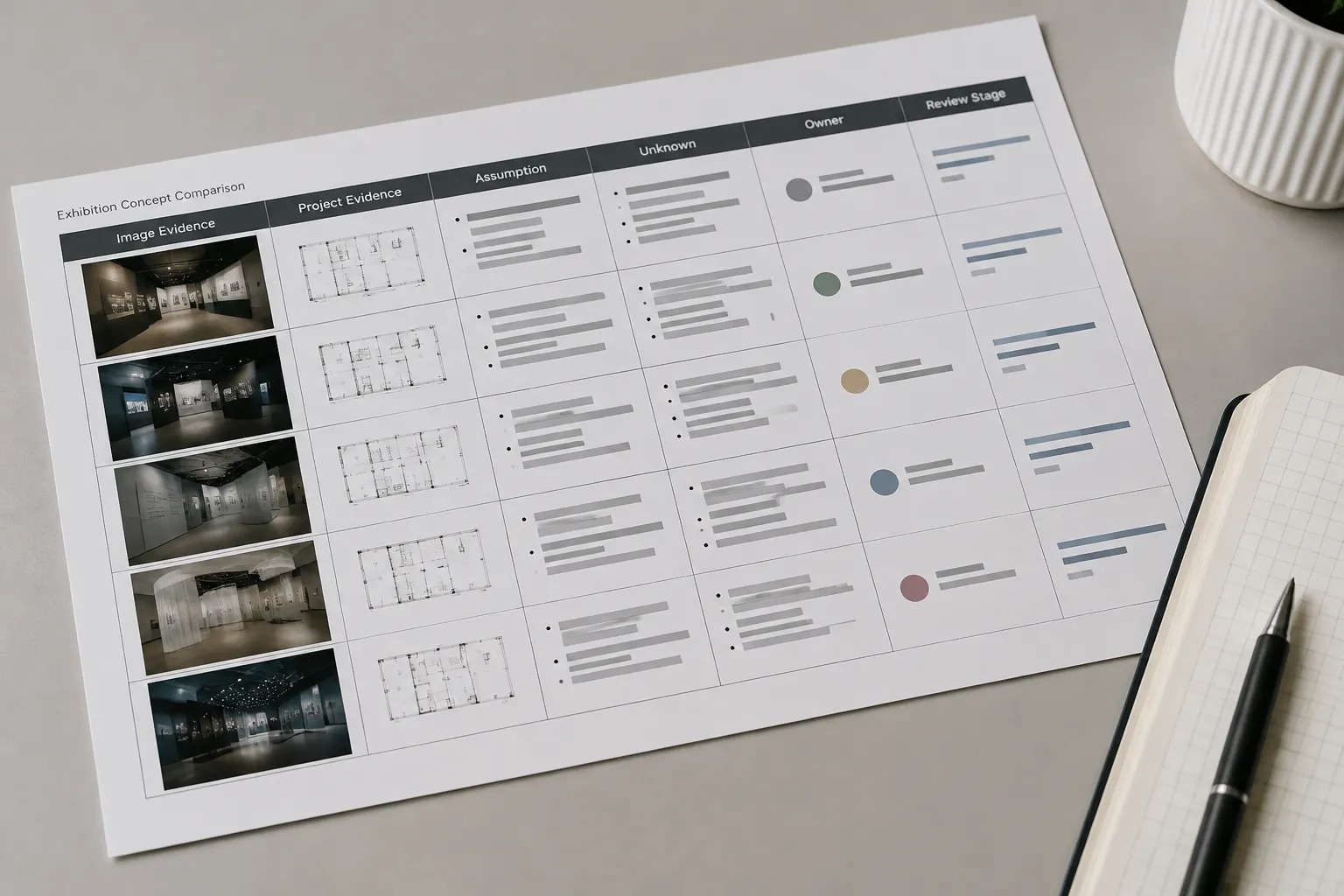
Compare Intent, Cue, and Recognition
Exhibitors, designers, and visitors can inspect the same concept through different lenses. The exhibitor may want a product to lead. The designer may use height, contrast, lighting, or placement to give it priority. A visitor approaching from the side may recognize only the logo and part of a screen.
These are related observations, but they are not interchangeable evidence.
| Viewpoint | Question to record |
|---|---|
| Exhibitor intent | What should the visitor recognize first? |
| Designer intention | Which visible cues are being used to create that priority? |
| Visitor view | What can be recognized from the stated approach angle? |
| Project record | Which priority is documented in the brief or campaign material? |
| Unresolved point | What changes if the intended cue is hidden or encountered later? |
This comparison avoids claiming that a concept will produce a particular engagement or commercial result. It asks whether the intended message can be identified from the view under review and whether the evidence is sufficient for the current decision.
A mismatch is a useful register entry. It does not prove that the concept has failed. It identifies the next design question: should the focal point move, should another approach view be tested, or should the campaign hierarchy be clarified?
Route Assumptions by Decision
“Look and feel” is too vague to assign. Group entries by visible project decisions so each question has a clearer path.
Focal Point and Sightline
Observation: From the corner approach, the largest graphic is visible while the product display is partly concealed.
Assumption: The large graphic may be intended to direct attention toward the product area.
Unknown: The preview does not establish whether that relationship remains clear from the main aisle or during arrival.
Next question: Ask the designer to compare the stated approach angles and identify the intended focal sequence.
Stage: Concept review.
Demo-Zone Threshold
Observation: The concept shows a screen and presenter position near the open edge of the stand.
Assumption: A visitor may understand where the demonstration begins without entering the zone.
Unknown: The preview does not establish the operating arrangement, equipment specification, circulation conditions, or venue constraints.
Next question: Ask the project lead and appointed supplier which information is needed before the arrangement is developed further.
Stage: Brief and handoff preparation.
Meeting Approach
Observation: A partly screened meeting area is visible behind the reception point.
Assumption: The screen may signal a transition from public browsing to a more private conversation.
Unknown: The image does not establish privacy, capacity, dimensions, accessibility, or approval conditions.
Next question: Ask the designer to document the intended threshold, then route dimensional and venue questions to the appropriate qualified role.
Stage: Concept comparison, with later specialist review required.
Campaign Imagery and Source Status
Observation: A campaign image appears on a wall panel in the concept preview.
Assumption: The project team may assume the image is available for the proposed use.
Unknown: The preview does not establish the image source, permission, territory, duration, or permitted placement.
Next question: Ask the rights holder or appointed project role to confirm source status and usage conditions.
Stage: Asset review before the artwork is treated as approved project material.
Walkthrough Preview
Observation: A walkthrough sequence suggests movement from the aisle toward the demo and meeting zones.
Assumption: The sequence may represent the intended visitor route.
Unknown: A non-technical preview does not establish actual venue conditions, final dimensions, construction details, utilities, or production readiness.
Next question: Ask the designer to label the viewpoints and identify which decisions remain illustrative.
Stage: Visual review and handoff preparation.
Use Review Stages, Not One Final Verdict
An assumption can be appropriate at one stage and insufficient at another. A rough concept may intentionally leave specifications open. A supplier handoff needs more precise information. An approval discussion needs the relevant documents and responsible decision-makers.
- Concept comparison: competing visual directions are judged under the same visitor position and brief priority.
- Design rationale review: the team records why a visible feature appears to serve a requested requirement.
- Brief clarification: missing information is added before another role develops the decision.
- Supplier or organizer question: the matter requires an appointed project role.
- Asset and permission review: source status or usage conditions remain unresolved.
- Handoff record: the question, evidence, owner, and current status are documented for the next project step.
Do not mark an entry answered merely because a reviewer prefers one image. Record the information supplied by the responsible source and state what that answer covers.
For venue, accessibility, safety, structural, utility, compliance, rights, or approval matters, preserve the question and route the determination to the appointed organizer, supplier, rights holder, or qualified adviser. The concept review can identify the gap; it should not decide the specialist matter.
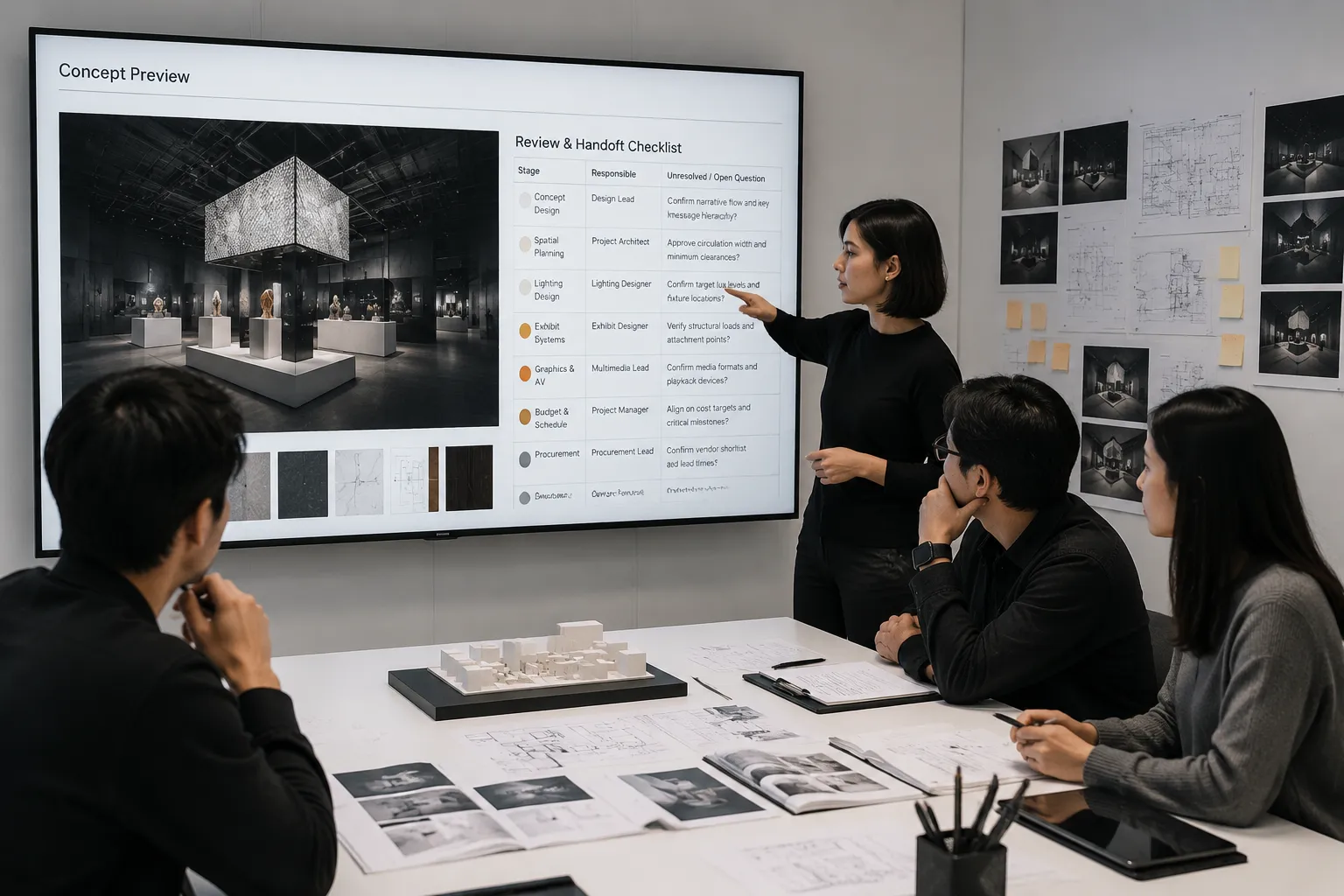
Worked Register Entry
The following is an invented exhibition scenario used only to demonstrate question routing.
A concept preview shows a tall illuminated brand wall behind a demo counter. From the front approach, the wall is the strongest visual cue. From the side approach, a neighboring structure appears to interrupt part of the view.
- Visible evidence: The brand wall is prominent in the front-facing preview and partly obscured in the side-facing preview.
- Interpretation: The design may be prioritizing recognition from the front approach.
- Assumption: The team may assume the same hierarchy applies to the principal aisle view.
- Unknown: The preview does not establish the neighboring context, dimensions, venue sightlines, or final placement.
- Evidence needed: Stated approach angles, developed layout information, and the brief's priority for the wall.
- Owner: Exhibition designer for visual comparison; appointed supplier or organizer for later project-specific determinations.
- Review stage: Concept comparison.
- Next question: Which approach angle governs the decision, and what should remain visible before a visitor reaches the demo threshold?
The entry does not confuse visual preference with a verified condition. It gives the next reviewer a bounded task.
Common Mix-Ups
A Preview Is Treated as a Specification
A polished image can communicate intent while omitting exact values, materials, sources, revisions, and conditions. Keep the preview status visible.
An Assumption Is Written as a Fact
Change “Visitors will see the product first” to “The product appears intended as the first focal cue from this approach.” The second version identifies an interpretation that can be checked.
One View Is Used for Every Review
Front, corner, threshold, demo-edge, and meeting approaches can expose different questions. Record the position that supports the decision.
Ownership Stops at the Designer
Some questions belong to the project lead, supplier, organizer, production role, rights holder, or qualified adviser. Routing is part of the register's purpose.
A Checklist Replaces Judgment
Fields preserve traceability, but they do not determine approval, accessibility, safety, legal rights, or project outcomes. Compare the visible cue with the decision actually being made.
Open Questions and Assumption Register Template
Use these fields for one review domain:
- Decision under review: What exhibition design decision is being compared or clarified?
- Approach angle or visitor position: From where is the concept being judged?
- What the image shows: Which focal points, sightlines, thresholds, graphics, or zones are visible?
- Intended hierarchy: What does the brief or project record say should be recognized first?
- Assumption created: What might a viewer infer from the preview?
- Confirmed evidence: Which source, revision, or project record supports the statement?
- What remains unknown: Which dimensions, specifications, permissions, approvals, or conditions are absent?
- Next question: What single answer would reduce the uncertainty?
- Responsible role: Who can provide or determine that answer?
- Review stage: At what point should the question be answered?
- Status: Open, awaiting evidence, routed, answered with limits, or carried forward.
- Decision affected: Which visual or handoff choice may change when the answer arrives?
Keep one meaningful question per entry where possible. Several unresolved matters can relate to the same image, but combining them often hides ownership.
The Handoff Checkpoint
Before a concept moves to another reviewer, read each open entry as a question rather than a complaint. The receiving role should be able to locate the relevant view, understand the visible cue, see the assumption, and know what answer is requested.
- Can the next reviewer locate the issue in the concept preview?
- Is the approach angle or visitor position stated?
- Is observation separated from interpretation?
- Does the record distinguish a preview from a developed document?
- Is the missing evidence named specifically?
- Is the next question assigned to the right role?
- Is the current review stage clear?
- Are specialist determinations left with the appointed role?
The register is useful when a team can say what the concept communicates, what it only suggests, and what must be answered before the next decision. That is the branch-level judgment: specific enough to guide review, limited enough to remain honest about the evidence.
Decision Rule
Use a design assumption register when a concept image creates a plausible reading that the project record has not confirmed. Record the visible cue, state the visitor position, name the assumption, preserve the unknown, and route one precise question to its owner.
A strong entry does not make the concept appear more complete than it is. It gives the project team a clearer basis for comparison and a more accountable path into the next review stage.
Leave the unresolved question easy to find, difficult to misread, and assigned to the role that can actually answer it.
Sources
- An Evaluation-Driven Design Process for Exhibitions
- Voila!: The Rockefeller Archive Center's Exhibit Creation Process
- Values-Led Design Cards: Building Ethically Engaged Archaeology and Heritage Experiences
- Feature, specification and evidence framework for communicating design rationale | Design Science | Cambridge Core
- Drawing evaluation into design for mobile computing: a case study of the Renwick Gallery's Hand Held Education Project
- Developing critical documentation practices for design researchers
- Brazil - Gestão do processo de design de arquitetura efêmera em museus