
Handoff Role Routing
A concept preview can show a focal point, a proposed sightline, or a relationship between visitor zones. It cannot show who owns the unresolved decision.
That gap slows exhibition handoffs. The exhibitor may see a strong brand moment, while the designer sees unfinished hierarchy, the supplier sees missing information, and the organizer sees a venue-dependent question. Each view can be reasonable. The next action still needs an owner.
This page focuses on design handoff responsibilities: how to review one visitor-facing decision domain, separate visible evidence from intent, and route the remaining question to the appropriate project role. The method supports visual planning and brief improvement. It does not determine venue, structural, accessibility, utility, safety, production, or rights outcomes.

More specific pages
These pages continue the topic in smaller, more specific directions.
What Design Handoff Responsibilities Cover
A design handoff transfers a decision with its current evidence, limits, owner, and review stage. Sending a render or walkthrough alone leaves too much open.
A useful handoff answers four questions:
- What does the material visibly show?
- What does the team want a visitor to recognize or approach?
- What remains unknown, unapproved, or unsupported?
- Which role should decide or verify the next point?
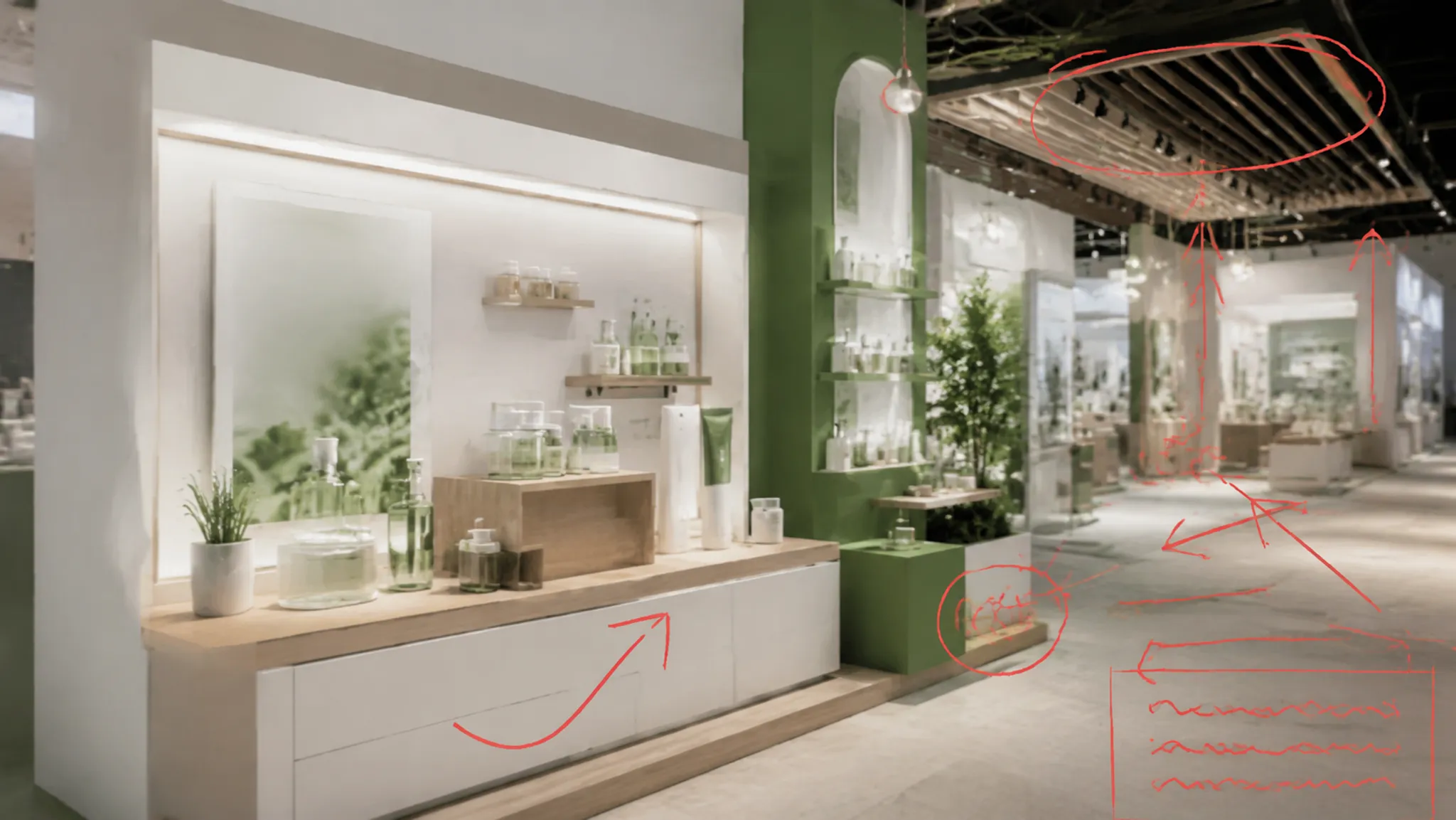
The image may depict a raised logo, a product display near the aisle, a meeting zone behind a threshold, or a screen facing an approach angle. It does not establish accepted dimensions, specified materials, documented asset permissions, or venue suitability.
A persuasive preview can therefore be useful without being a developed specification.
Start With One Visitor-Facing Decision Domain
Route responsibilities around a specific visible question rather than reviewing the entire booth as one impression. “The booth feels open” is difficult to assign. “From the left aisle approach, the main message is partly hidden behind the demo structure” gives the team an observable issue.
Suitable decision domains include:
- the primary brand focal point from the main aisle
- the legibility of a demo zone at its threshold
- the separation between public approach and meeting entry
- the campaign image supporting the intended message at the shown distance
- the sequence from entry to a likely dwell point
- the source status of a prominent image, logo, or graphic
- the hierarchy between the main offer and supporting information
Fix the Approach Angle
Review the same option from consistent positions:
- the main aisle approach
- a diagonal approach from an adjoining stand
- the zone threshold
- the demo edge
- the meeting approach
- the likely dwell point
- the view used in the pitch board or walkthrough
The purpose is not to predict every visitor response. It is to identify what the supplied view permits the team to judge and what it leaves unresolved.

Separate Intent, Recognition, and Evidence
Exhibition teams often combine three different statements:
- “We want visitors to notice the product first.”
- “The product is the largest object in the image.”
- “Visitors will understand the product’s value immediately.”
The first records intent. The second describes a visible feature. The third requires evidence beyond the preview.
A visitor-view design review becomes more precise when each statement is placed in its own layer.
| Review layer | Useful question | What the material can support |
|---|---|---|
| Client intent | What should the visitor notice, understand, or approach? | A documented campaign or project priority |
| Design interpretation | How has that priority been represented? | Visible hierarchy, placement, contrast, sequence, or zone relationship |
| Visitor recognition | What can a visitor identify from the selected view? | A bounded observation about apparent emphasis or legibility |
| Developed information | What is documented beyond the image? | Briefs, drawings, specifications, source records, or review notes |
| Approval status | What has been accepted, by whom, and at what stage? | Only an explicit project record |
The final two layers should not be inferred from a concept preview. A polished image may still represent an early review stage.
Exhibition Concept Handoff Responsibility Matrix
Use the matrix as a routing aid for visual review. It does not assign legal, structural, venue, accessibility, or production authority by itself.
| Decision or observation | First question | Likely owner or next role |
|---|---|---|
| Primary focal point | What must be recognized first from the main approach? | Client or exhibitor, with the designer |
| Brand hierarchy | Which message, mark, product, or campaign element receives visual priority? | Client and designer |
| Visitor sequence | What should be visible at the aisle, threshold, demo edge, and meeting approach? | Designer, with content or interpretation input where relevant |
| Content meaning | Is the displayed message accurate, complete, and suitable for the intended audience? | Content owner or interpretation role |
| Graphic or campaign asset | Where did the image, artwork, logo, or text originate, and what is its source status? | Rights holder or appointed rights adviser |
| Zone relationship | Does the concept depict the intended relationship between public, demo, and meeting areas? | Designer and client |
| Missing dimensions or specifications | What information is needed before another party can assess the proposal? | Designer, then appointed supplier |
| Venue-dependent question | Does the proposal need to be checked against organizer information or venue conditions? | Organizer or appointed project contact |
| Fabrication or installation question | What can be supplied, installed, or revised within the project requirements? | Appointed supplier or production role |
| Unresolved approval | Who has authority to accept this decision at the current review stage? | Named project decision-maker |
The most useful record names one owner for each open question. Several people may contribute, but shared discussion should not become ownerless responsibility.

Match the Artifact to the Decision
A single render rarely carries every decision required for handoff. Each artifact should state the question it is designed to answer.
Concept Preview
Use a concept preview to discuss focal points, visitor-view impressions, depicted sightlines, relative scale as shown, graphic hierarchy, apparent zone relationships, and the sequence presented in a still or walkthrough.
Label it as a non-approved concept preview when no approval record is available. The preview does not establish final dimensions, construction suitability, utilities, accessibility, venue acceptance, source permission, or production readiness.
Brief
Use the brief to record the intended visitor-facing priority, campaign or business context supplied by the client, required zones, known constraints, review stage, decision owner, and questions requiring a response.
Separate requirements from preferences. “The demo must be visible from the main aisle” is a reviewable instruction. “The booth should feel more premium” needs translation into location, scale, material indication, contrast, or another visible decision.
Option Board
Use an option board when alternatives are compared under the same conditions. Each option should identify:
- the approach angle
- the focal point
- the relevant zone
- the decision being tested
- the visible advantage
- the unresolved tradeoff
- the owner of the next question
Matched comparison prevents one option from receiving a more favorable viewing position or a less demanding review standard.
Review Note
Use review notes to preserve the difference between observation and interpretation. A practical entry might read:
- Observation: From the front-right aisle view, the campaign panel appears before the product display.
- Interpretation: The composition may place campaign recognition ahead of product recognition.
- Question: Is that the intended visitor sequence?
- Owner: Client and designer.
- Next stage: Revise the hierarchy or confirm the current direction.
The note does not need to resolve every issue. Its value is making the next decision visible.
How to Route Common Handoff Questions
When Intent Is Unclear
If the team cannot agree on what the visitor should notice first, route the question to the client or exhibitor before requesting another visual solution from the designer.
The designer can propose hierarchy, placement, and contrast. The client still needs to define the priority being represented. Without that decision, revisions may change the image without resolving the brief.
When the Message Is Clear but the Cue Is Weak
If the priority is documented but its visual counterpart is difficult to identify from the approach angle, route the issue to the designer.
Name the cue causing confusion:
- The logo is visible but secondary to a large campaign image.
- The product appears inside the demo zone but is blocked from the aisle view.
- The meeting entrance is present in the render but not legible as a threshold.
- Supporting text competes with the primary message at the same apparent scale.
This is a design interpretation question, not a request for a general “more impactful” treatment.
When Content and Visual Hierarchy Conflict
A content owner may want more information visible. The designer may need fewer competing elements to preserve a clear focal point.
Route the disagreement as a question about audience priority. The content role can confirm what must remain accurate or present. The designer can compare how different amounts and placements change the visitor view. The client or designated decision-maker resolves the priority when those roles disagree.
When a Preview Raises a Supplier Question
A concept image may depict a structure, display, surface, lighting treatment, screen, or installation condition. It can identify the intended visual treatment, but it cannot settle whether the proposal is suitable for fabrication or installation.
Record the visible intent and route the missing technical question to the appointed supplier or production role. Common unknowns include:
- dimensions
- material specification
- weight or fixing information
- equipment requirements
- installation sequence
- utility provision
- production timing
The supplier assesses information within its appointed scope. A concept reviewer should not present that assessment in advance.
When the Question Depends on the Venue
A preview may show an intended orientation, overhead element, access route, or neighboring relationship. Venue-specific conditions remain outside the image.
Route these questions to the organizer or the role responsible for venue coordination. Include the relevant venue, event, version, and date in the project record when those details can change. Sending the issue for review does not make the concept accepted.
When Source Status Is Uncertain
A campaign image, logo, illustration, quotation, video frame, or product photograph may suit the composition while its source status remains unknown.
Record the asset name, location, source record, documented permission or license status, intended use, missing confirmation, and responsible rights holder or adviser.
A visual review can identify that an asset is present and that its source status is unknown. It cannot determine permission from appearance alone.
Design Handoff Review Criteria
Judge whether the artifact supports the next decision, rather than whether it looks finished.
Visitor Position
Is the relevant approach angle identified? A focal point that reads from a centered front view may disappear from a side approach.
Visible Hierarchy
Can the team describe what appears primary, secondary, and supporting? Replace broad adjectives with location, scale, contrast, orientation, and sequence.
Zone Threshold
Can the viewer identify where the public approach changes into a demo or meeting interaction? If the threshold is ambiguous, record that as an open design question.
Decision Ownership
Does each unresolved issue have one named owner or responsible role? Contributors can be listed separately from the decision-maker.
Source Status
Are visible campaign and brand assets supported by a source record? Unknown status should remain marked unknown.
Review Stage
Does the artifact state whether it is an early concept, comparison option, developed proposal, supplier input, or approval record? A polished image can still belong to an early stage.
Next Action
Does the note state what happens next? “Review with supplier” becomes useful when paired with the exact missing information.
A Worked Example: The Demo Zone From the Aisle
Consider an invented scenario. A non-approved concept preview places a product display near the front edge of a booth. The client says the product should be the first visitor cue. From the selected aisle view, however, a tall campaign panel occupies the strongest visual position.
- Observe: The campaign panel appears before the product display from the stated approach angle.
- Interpret carefully: The composition may communicate campaign recognition before product recognition.
- Confirm intent: The client or exhibitor confirms whether the product or campaign should lead.
- Test design options: The designer compares changes to placement, scale, orientation, or contrast.
- Check content: The content owner confirms the wording and product emphasis.
- Record production questions: The supplier receives the developed proposal and missing dimensions or material information.
- Track status: The review note identifies the current stage and leaves approval open unless a project record confirms it.
The image has exposed a hierarchy conflict. It has not established how visitors will behave or whether the eventual arrangement suits venue or production conditions.
Common Confusions in Responsibility Routing
“The Designer Owns Everything Visual”
The designer may shape the visual interpretation, but the client or exhibitor supplies the business or campaign priority being represented. Content owners may control factual wording. Rights holders may control asset permissions. Other project roles may need to assess venue or production questions.
Separate visual treatment from the decision that gives it purpose.
“The Supplier Can Resolve an Unclear Brief”
A supplier may clarify what information is needed for its scope. That does not determine which message should lead, which audience priority matters, or what the visitor should recognize.
Resolve intent and hierarchy before sending unresolved strategic decisions downstream.
“A Render Is an Approval Record”
A render is an image. An approval record identifies the decision, decision-maker, date or review stage, and conditions attached to acceptance.
Keep those artifacts separate.
“Visitor-Facing Review Means Visitor Testing”
A visitor-view review inspects what a concept depicts from selected positions. It is not the same as documented visitor evaluation or testing.
If the project needs evidence about visitor recognition, the responsible team must define an appropriate evaluation approach. The concept preview alone cannot supply that evidence.
When the Material Cannot Support a Conclusion
Some questions should remain open. If the image omits the approach angle, mark the viewpoint unknown. If dimensions are absent, describe scale as depicted rather than documented. If the source record is missing, mark the asset status unknown. If approval authority is not identified, route the question to the project decision-maker.
Research on exhibition roles, iterative review, and intermediary artifacts can support a bounded discussion of responsibility routing. It does not establish a universal commercial handoff standard, supplier practice, venue requirement, accessibility assessment, safety assessment, rights decision, visitor-test result, or production outcome.
That limit identifies where project evidence must replace editorial inference.
A Compact Handoff Record
For each visitor-facing issue, capture:
- Decision domain: focal point, zone threshold, campaign asset, visitor sequence, or another defined topic
- Approach angle: the view used for review
- Visible cue: what the image, board, or preview depicts
- Intended recognition: what the client wants the visitor to notice or understand
- Interpretation: how the visible cue may support or conflict with that intent
- Evidence status: depicted, documented, specified, or unknown
- Open question: the unresolved issue in concrete terms
- Owner: the role responsible for the next decision or verification
- Next artifact: revised board, brief note, source record, supplier query, organizer review, or approval record
- Review stage: the current status of the decision
This record turns “please review the concept” into a traceable handoff.
Final Check: Route the Question, Not Just the File
Before passing a concept to another role, ask:
- What visitor-facing decision is being reviewed?
- Which approach angle supports the observation?
- What does the concept visibly communicate?
- What is intent rather than evidence?
- Which details remain unknown?
- Who owns the unresolved question?
- What artifact should carry the next decision?
- What review stage follows?
- Which determinations belong to the organizer, supplier, rights holder, or qualified adviser?
A useful handoff does not make every question disappear. It makes the next question precise, visible, and owned.
That is the practical value of design handoff responsibilities: the team can distinguish a convincing concept preview from documented project information, compare visitor-facing choices under the same conditions, and move each unresolved issue to the role equipped to address it.
Sources
- The Making of Exhibitions: Purpose, Structure, Roles and Process
- An Evaluation-Driven Design Process for Exhibitions
- Management of the Design Process of Ephemeral Architecture in Museums
- Digital Exhibition Design: Boundary Crossing, Intermediary Design Deliverables and Processes of Consent
- An Advocate for Everything: Exploring Exhibit Development Models
- Voila!: The Rockefeller Archive Center's Exhibit Creation Process
- Empowering Cultural Heritage Professionals with Tools for Authoring and Deploying Personalised Visitor Experiences