
Handoff Completeness and Ambiguity Checks

A concept handoff can look finished while leaving the next project role with unresolved decisions. Polished lighting, populated meeting areas, and convincing materials communicate intent, but they do not establish dimensions, specifications, permissions, or approval status.
A useful design handoff checklist separates two questions:
- What does the concept communicate from the relevant visitor position?
- What does the handoff record actually confirm for the next review stage?
The first question tests the visitor view. The second tests the maturity of the supporting information. Neither determines buildability, accessibility, safety, venue acceptance, rights clearance, or readiness for fabrication.
The practical task is to identify what is visible, record what is known, mark what remains unresolved, and route each question to a named decision owner.
More specific pages
These pages continue the topic in smaller, more specific directions.
What Makes a Concept Handoff Complete?
Completeness depends on the next decision. A campaign review needs different information from a supplier feasibility review or an organizer submission.
A handoff is complete for a particular stage when the receiving role can identify:
- what each artifact represents;
- which revision is current;
- which visitor position or project condition it addresses;
- what has been decided and what remains provisional;
- who owns each unresolved decision; and
- which confirmation is required next.
This is a task-specific threshold, not a universal finish line.
NIST guidance on facilities information handover emphasizes identifiable information packages, metadata, timing, access, handover points, and responsible parties. It does not establish exhibition approval criteria. Its useful principle here is narrower: source, status, timing, and ownership should travel with the information.
Research on engineering information maturity also separates representational detail from confidence and commitment. A highly detailed image may contain assumptions, while a simple diagram may document a reliable decision.
For an exhibition handoff, keep four information levels distinct:
- Visible cue: The image depicts an entrance, graphic surface, counter, screen, or meeting enclosure.
- Documented intent: The board identifies the intended role of that element.
- Developed information: Dimensions, materials, assets, dependencies, or other required details have a stated status.
- Recorded decision: The responsible role has documented a decision for a named review stage.
A convincing image remains a concept preview unless its accompanying records establish more.
Start With the Visitor Position
A single elevated perspective may describe the overall composition while concealing weak thresholds, blocked graphics, or unclear zone relationships. Inspect the aisle, threshold, demo edge, and meeting approach before relying on the designer’s explanation.
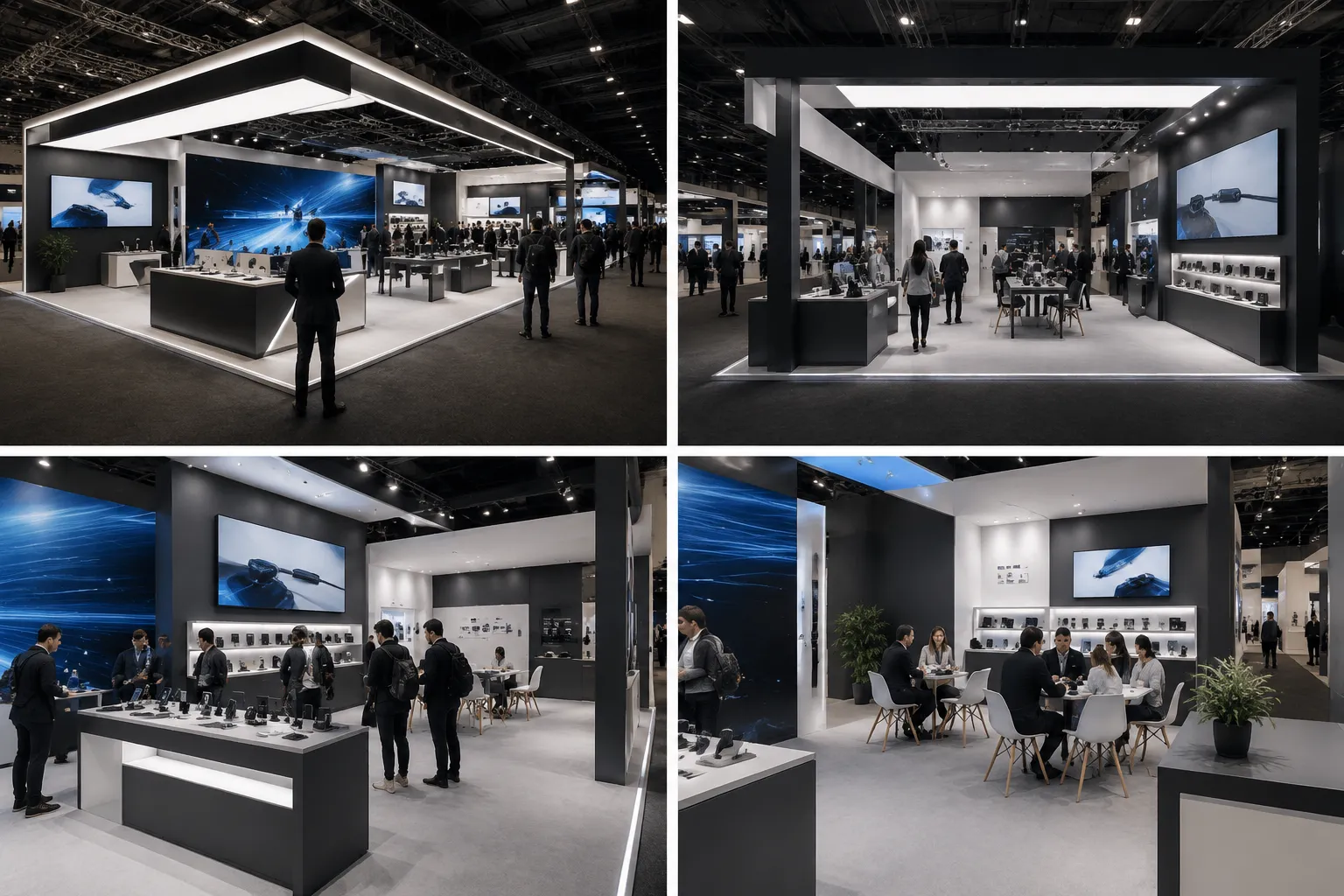
Aisle view
From the aisle, record what a passing visitor can recognize without already understanding the layout:
- the first visible brand or campaign cue;
- the dominant focal point;
- the apparent entrance;
- graphics obscured by structures, furniture, or people;
- competing screens, signs, or illuminated elements; and
- the viewing direction and approximate approach angle.
Replace “bold presence” with observable information. A high-level brand field faces the main aisle, a product image occupies the central wall, or two illuminated screens compete for attention.
Then inspect the record. Is the primary approach identified? Is the aisle orientation confirmed, provisional, or unknown?
Threshold view
The threshold is where visual invitation becomes a spatial decision. Note the apparent opening, nearby furniture, changes in flooring or lighting, the start of the demo zone, and sightlines toward meeting or storage areas.
“Open” might refer to a clear floor edge, several visible entry points, low furniture, or an uninterrupted sightline. These are different design decisions. The adjective alone does not tell the next role which condition should be preserved.
If dimensions are absent, record the threshold size as unknown. The image can suggest an opening but cannot establish measured clearance or suitability for a particular requirement.
Demo-edge view
From the demo edge, distinguish a display surface from an interaction point, a circulation route from a dwell point, and illustrative equipment from equipment expected in the developed stand.
When a screen appears above a counter, record its purpose, content owner, asset status, assumed equipment, and supplier dependencies. The preview does not establish mounting, utilities, structural support, or venue acceptance.
Meeting approach
Observe how visitors recognize the meeting zone and how its separation relates to the intended conversation. Check its threshold, visibility from the aisle, nearby demo activity, retained brand cues, and the route into the space.
Terms such as “premium” or “private” need visible support. Restrained graphics, material contrast, controlled lighting, screening, or orientation may express those intentions. An image cannot establish acoustic or operational performance.
Design Handoff Checklist for Exhibition Concepts
Use these checks as editorial prompts for the current handoff. They are not an exhibition standard or a substitute for the applicable supplier, organizer, venue, rights holder, or qualified adviser.

Artifact identity and review purpose
Every image, board, diagram, clip, and schedule should carry an identifiable purpose. Record its title, identifier, revision date, issuing role, intended review stage, relevant option, and receiving role.
A perspective labelled “final render” can create false confidence when “final” only means the selected concept image. Use status language tied to a decision, such as “selected for campaign review” or “issued for supplier questions.”
Approach-angle coverage
Choose views according to the current decision. The set may include the main and secondary aisle approaches, threshold, demo edge, meeting approach, staff position, and an overhead orientation view.
Not every project needs every view. Document an omitted viewpoint when its absence could change the judgment. An absent view is not evidence that no conflict exists.
Zone and threshold labels
Use stable names across concept boards, plans, schedules, and comments. Identify welcome points, demos, product displays, meeting areas, hospitality, storage, circulation paths, and zone thresholds where relevant.
“Engagement zone” could mean a demonstration point, conversation area, or open circulation space. Replace it with the intended visitor action and operational purpose. Number repeated counters or screens so comments identify the correct element.
Brand hierarchy documentation
Record the primary brand identifier, campaign message, product focal point, supporting content, intended reading order, content owner, and asset status.
The image indicates what appears dominant in that composition. The board should say whether that dominance is intentional. Compare alternatives from the same visitor position; changing both the camera and graphics obscures what caused the difference.
Dimensions and scale status
Mark dimensions by information state rather than inferring them from visual realism. Project labels might include unknown, assumed for concept development, awaiting confirmation, supplied by a named source, or accepted for a specified downstream task.
Check boundaries, major heights, openings, counters, screens, graphic fields, product displays, and zone relationships when they affect the current decision. A person or chair in a rendering is a scale cue, not a measured specification.
Material and finish status
A rendered surface may suggest color, reflectivity, texture, and visual weight. It does not identify the product, assembly, substrate, finish system, availability, or suitability.
For each important treatment, distinguish a mood reference from an intended finish direction. Record any material family, sample, code, color target, current status, and owner of the next confirmation.
Graphic sources and permission status
Each graphic should be traceable to an asset identifier, supplying party, original file location, version, intended placement, modification notes, and content owner. A screenshot may communicate the idea without being the correct downstream asset.
Track permission separately from file provenance. Record the rights holder or supplying party when known, intended usage, scope, modification status, evidence location, confirmation owner, current status, and latest confirmation date.
A source record identifies the file being considered. It does not determine permitted use. If supporting records are absent, permission status is unknown and requires confirmation by the appropriate rights holder or adviser.
Revision state and decision ownership
Confirm that plans, perspectives, graphic boards, comments, and schedules refer to the same option. Mark superseded files, record changed decisions, and identify outstanding actions.
“Updated” does not explain what changed, why it changed, or which affected roles reviewed the result. Every unresolved question needs one accountable role and one required action.
A designer may identify a missing graphic record, while the content owner provides the asset and the rights holder confirms permitted use. Ownership should match the decision being requested.
Handoff Ambiguity Checks
Completeness checks locate missing material. Ambiguity checks locate material that exists but supports more than one reasonable interpretation. A full folder can still produce an unclear handoff.
Vague language
Flag directions such as open, bold, premium, immersive, flexible, welcoming, or high impact. Translate each term into expected spatial, graphic, or operational cues.
“Make the entrance more open” could mean moving a counter, lowering a display, widening the apparent entry, or opening another aisle edge. It needs clarification before becoming a usable change instruction.
Unidentified references
Words such as “this,” “front,” “back,” “left,” or “main” depend on viewpoint. Replace them with an artifact identifier, view name, zone label, element number, visitor orientation, or an existing plan reference.
Mismatched artifacts
Compare related files rather than inspecting each alone. Look for zones missing from plans, furniture omitted from perspectives, conflicting headlines, inconsistent screen positions, different material labels, or comments attached to superseded options.
A mismatch is not automatically an error. One artifact may be newer or deliberately simplified. Record which representation controls the next decision and who must reconcile the others.
Hidden assumptions
List assumptions only when they affect the current review. Relevant examples include visitor approach, demonstration count, product size, screen content, staffing positions, furniture quantity, storage demand, neighboring stands, and campaign asset availability.
Mark each assumption as confirmed, provisional, conflicting, or unknown.
Status ambiguity
Words such as approved, final, selected, locked, and ready can refer to different decisions. Record who made the decision, its purpose, date, revision, stage, and exclusions.
A preferred visual direction may be selected while dimensions, materials, graphics, permissions, and supplier feasibility remain open. The status label should preserve that distinction.
Missing comparison criteria
Before comparing options, align the visitor position, campaign objective, required zone function, review stage, known constraints, information status, and decision owner.
Then compare the same variables. A composition viewed from a favorable camera angle may read differently from the allocated aisle approach.
Audit Claims of Readiness in a Concept Handoff
Test the basis of a readiness claim, not the confidence of its presentation. Locate each status label that implies downstream commitment and identify the accompanying record.
| Claim area | What the preview may communicate | What the handoff should identify | Next confirming role |
|---|---|---|---|
| Layout | Apparent zone arrangement and circulation | Current plan, dimensions, assumptions, and revision state | Designer and appointed supplier |
| Materials | Intended color, texture, and visual effect | Material status, references, samples, and unresolved substitutions | Appointed supplier and project decision owner |
| Graphics | Placement, scale, and hierarchy | Current assets, source records, content status, and permission status | Content owner, rights holder, and supplier |
| Screens and demos | Location and intended visitor relationship | Equipment assumptions, content purpose, dependencies, and open questions | Appointed supplier and relevant technical roles |
| Review status | A selected or refined visual direction | Reviewing party, purpose, date, revision, and exclusions | Named decision owner |
| Organizer submission | Material assembled for a later review | Applicable requirements, current source, date, and submission owner | Organizer, venue, or appointed supplier |
If the relevant source, project stage, date, venue, jurisdiction, license, or decision record is absent, mark the matter as unknown. Route it to the role responsible for the determination.
Worked Concept Handoff Audit

A perspective depicts a corner stand with an illuminated logo, an open front edge, two demonstration counters, and a screened meeting area. The campaign board describes the direction as “open, immersive, and premium.”
From the main aisle, the logo is the first visible brand cue. One demonstration screen competes with the campaign headline, while the nearest counter narrows the apparent threshold.
What the preview communicates
- The illuminated logo appears to be the long-range focal point.
- The front counter creates a recognizable demonstration dwell point.
- The meeting screen suggests visual separation from the aisle.
- Darker finishes and restrained graphics support the stated visual direction.
What the record establishes
- The board identifies the main-aisle view.
- Two demo zones are labelled differently on the plan and perspective.
- The logo asset has an identifier and revision.
- The campaign image has a source note but no recorded permission status.
- The dark wall finish is described only as a visual reference.
- The threshold width is not dimensioned.
- The meeting screen has no material status.
- The concept is marked “selected” without a reviewing role or purpose.
Questions to route
The campaign lead should confirm the intended message hierarchy. The designer should reconcile the zone labels and identify which visual cues define the selected direction.
The content or rights owner should update the image permission record. The appointed supplier should inspect dimensions, materials, equipment assumptions, and development dependencies under the actual project conditions.
Questions within organizer, venue, or specialist authority should go to those roles with the relevant project context. The preview cannot settle them.
Record and Route Unresolved Questions
A usable issue record contains enough context for the receiving role to act. For each question, record:
- artifact and revision;
- visitor position or affected zone;
- visible observation;
- missing or conflicting information;
- current information state;
- decision required and decision owner;
- required source or confirmation; and
- target review point and dependencies.
Observation: From the secondary aisle, the product image is partly concealed by the demo screen.
Ambiguity: The board does not identify whether the product image or screen should have priority from this approach.
Decision: Confirm the intended focal point and acceptable obstruction.
Owner: Campaign lead, with the designer updating the hierarchy record.
Dependency: Current screen dimensions and content format remain unknown.
This structure keeps visual interpretation connected to project action without turning an observation into a technical determination.
A Practical Review Sequence
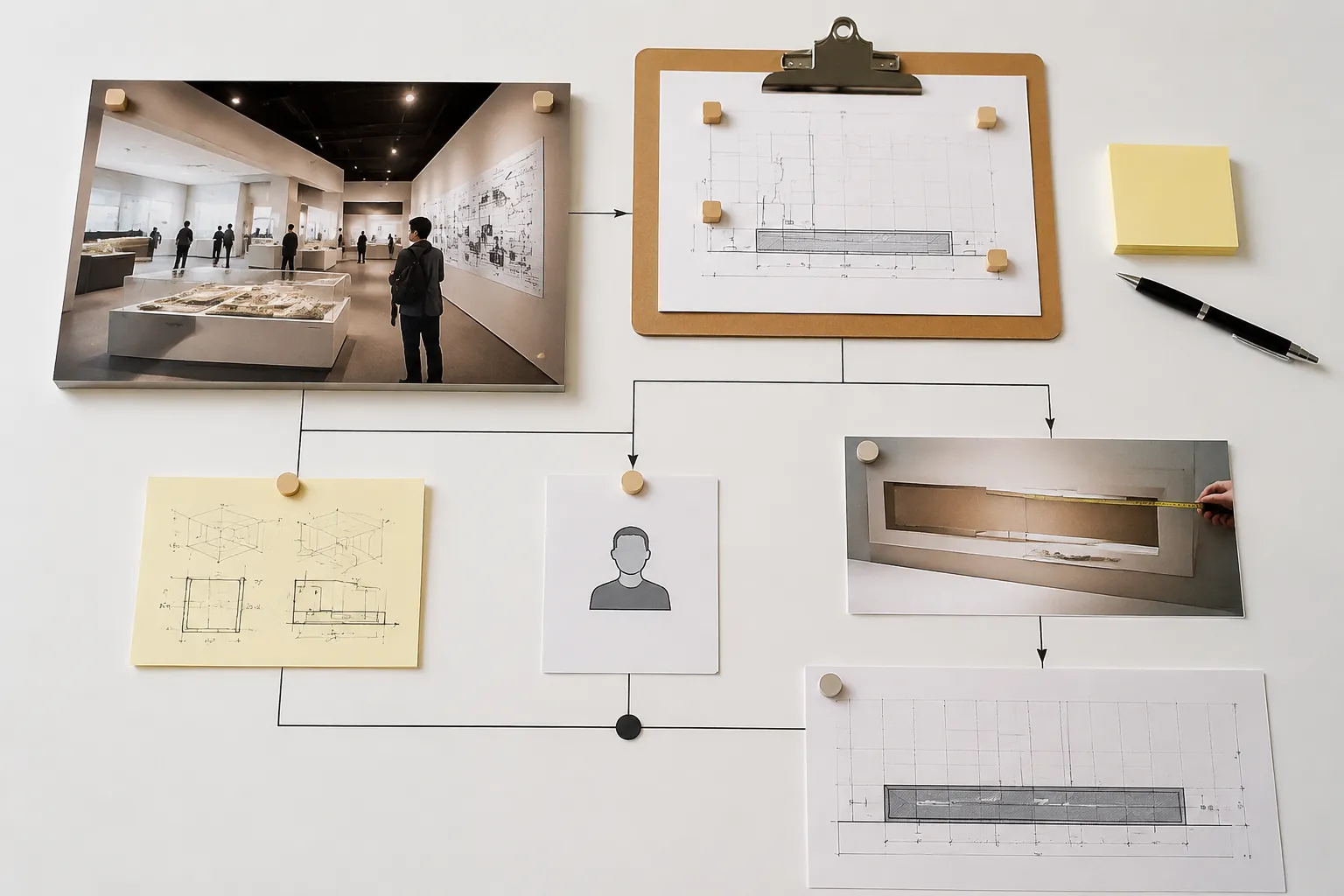
- Name the visitor position. Identify the aisle, threshold, demo edge, meeting approach, or other relevant viewpoint.
- Record the visible cue. Describe what the supplied image depicts without assigning unsupported performance.
- Interpret the likely effect. State what appears dominant, concealed, inviting, conflicting, or difficult to recognize.
- Check the artifact record. Verify its title, revision, source, stage, owner, and intended use.
- Inspect supporting information. Review labels, dimensions, materials, graphics, permissions, dependencies, and decision history.
- Mark the information state. Distinguish confirmed, provisional, conflicting, superseded, and unknown information.
- Write one unresolved question. Avoid combining several decisions in a vague comment.
- Assign the decision owner. Route the question to the role with the information or authority to answer it.
- Define the next confirmation. Name the record, source, review, or decision that can close the issue.
- Update connected artifacts. Keep the answer from remaining isolated in a comment thread.
Structured checklists can expose omissions, conflicting records, and unclear ownership. The selected research supports those general review mechanisms, but it does not provide exhibition-specific rules for fabrication, accessibility, safety, rights, or venue decisions.
The handoff reaches its next usable stage when the receiving role can see the intended visual direction, the status of the supporting information, and the limits of the current record. Revise the brief so each remaining uncertainty has one owner and one named confirmation.
Sources
- Capital facilities information handover guide, part 1
- Aspects of information maturity in design and development | Research in Engineering Design
- Critter: Augmenting Creative Work with Dynamic Checklists, Automated Quality Assurance, and Contextual Reviewer Feedback
- ASSESSING, AGGREGATING AND VISUALISING PRELIMINARY DESIGN INFORMATION MATURITY TO SUPPORT COLLABORATIVE DESIGN